
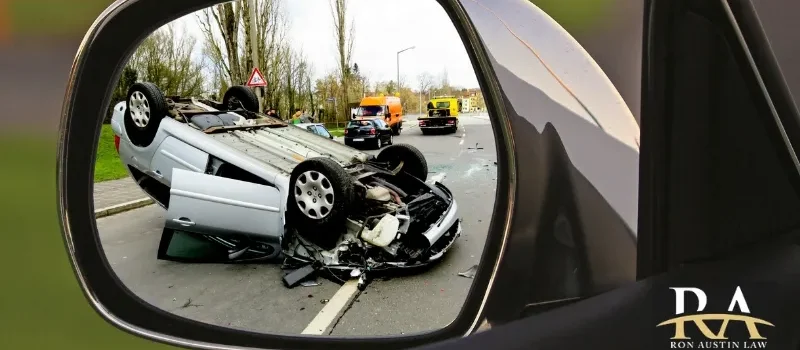

A rollover or overturn accident is one of the most overwhelming types of vehicle collisions and has the potential to cause serious injuries. What happens to your body in a rollover accident? The force of the rollover itself, other objects in the vehicle, and even seat belts can cause impacts and injuries. Rollovers are even more likely to be deadly without a seatbelt or if ejection happens for any other reason.
What Causes Injuries in a Rollover Accident
There are several forces in a rollover or overturn accident that can cause many types of injuries, including:
- The motion of the vehicle. While other crashes usually involve the force of the crash from one direction, rollover accidents rotate the vehicle, potentially multiple times. Occupants feel the force of the crash in multiple directions and collide with the interior of the vehicle in multiple directions.
- Seatbelts. The force of the seatbelt preventing ejection can cause severe chest and internal injuries. However, preventing ejection is key to reducing the risk of fatal injuries.
- Loose objects. Objects in the vehicle that are not properly restrained are much more likely to fall around the vehicle in a rollover, causing additional injuries.
- Roof. Rollovers can cause the roof of a vehicle to partially collapse, limiting space, causing further collision with the interior of the vehicle, and causing injuries.
Common Injuries in Rollover Accidents
Some rollover collisions do not cause severe injuries, while others cause significant harm and fatalities. There is a higher potential for injury in these crashes because of the many forces involved in the accident. Injuries can include:
- Traumatic brain injuries, from minor concussions to penetrating brain injuries
- Post-traumatic stress disorder and other mental and psychological harm
- Fractured bones
- Contusions
- Lacerations
- Crushing injuries
- Burn injuries
- Internal bleeding and internal organ damage
- Neck and back injuries, including severe whiplash
- Facial injuries, including eye damage
- Spinal cord damage, including paralysis caused by spinal cord severing
- Limb loss and amputations
After an accident, it is crucial that you get medical treatment. This includes emergency responders at the scene and also from a nearby hospital. Getting medical care is necessary to protect your own health and potentially limit the long-term effects of your injuries. It also ensures documentation of the injuries you sustained.
What Should You Do Immediately After a Rollover Accident?
What you do immediately after a rollover accident is important to help safeguard your health and your ability to file a claim in the future. However, if you were seriously injured, your focus should solely be on getting medical care. The other steps in the process can wait until you are stable.
If you have the ability to, you should take the following steps immediately after a rollover accident:
- Get to safety. If vehicles can be driven, drive them out of the immediate roadway. If the vehicles cannot be moved, leave them and move yourself to a safe place nearby. Help others and check for injuries. If someone is seriously injured and can’t move out of the vehicle themselves, do not attempt to move them unless it is an emergency, as it could worsen their injuries.
- Report the accident. Call 911 to report the crash and the injuries you know of. This ensures emergency responders arrive at the scene and that there will be a police report of your accident. In Louisiana, you likely must report any accident with an injury, death, or $500 or more in damages, although the exact accident reporting requirements may vary based on the parish. It is a good idea to report an accident to support your claim in the future.
- Exchange information. While you wait for emergency responders, you may want to exchange information with the other driver or drivers in the accident. This includes basic contact information and their insurance policy information. If there were other eyewitnesses to the scene, either passengers or third parties, you should also request their contact information.
- Document the scene. Take photos and videos of the scene as evidence. This includes documenting the vehicle, your injuries, skid marks, surrounding property damage, road and weather conditions, any traffic lights, and other relevant information.
- Get medical care. When emergency medical providers arrive on scene, get medical care when prompted. Even if you think you weren’t injured, you should be looked over. Some injuries may be hard to notice, especially if you are suffering from shock. Getting medical care is necessary to protect your own health and potentially limit the long-term effects of your injuries. It also provides documentation of the injuries you sustained.
- Provide information. Local law enforcement will arrive at the scene with emergency responders, such as the Louisiana State Police or a parish sheriff’s office. When they ask, provide information for the police report. Be honest and don’t guess about information you don’t actually know.
- Report the crash to your insurer. If your vehicle was involved in the accident, you likely must report the incident to your insurer, regardless of who was to blame. Provide them with basic facts without admitting fault.
- Go to a hospital. Even after receiving emergency medical care, you should get further treatment from your medical provider or urgent care. This makes sure there is additional documentation. Medical providers in healthcare facilities also have access to more equipment than emergency medical providers.
- Get legal support. It is easier to recover financially when you have an attorney to file an insurance claim and advocate for you. An attorney can investigate the incident and negotiate with the involved insurance companies for reasonable financial compensation.
What Causes Rollover Accidents?
Many rollover accidents happen because of a prior collision, such as with other vehicles. Some happen without any prior collision or impact. These crashes can be caused by:
- Speeding, especially around sharp turns or curves
- Swerving on the road to avoid a hazard
- Vehicles that are top-heavy with cargo
- Otherwise improperly loaded and overloaded cargo
- Top-heavy vehicles, like SUVs or large trucks
- Poorly designed vehicles that are prone to overturns
- Distracted driving
- Impaired driving
- Other reckless actions, like unsafe lane changes
- Hazardous road conditions, like debris or severe road damage
- Weather conditions, including flooded roads or high winds
The cause of a rollover accident is important. After a crash, you may be able to file a claim with the at-fault party to recover key financial and personal losses. How the accident happened can help point to the at-fault party. For example, a rollover on a turn may be the fault of a driver for going too fast, or it may be the fault of a road maintenance agency for failing to provide a reduced speed sign.
FAQs
What Happens to Your Body in a Rollover Accident?
In a rollover accident, your body deals with interior collisions during the collision and force from multiple directions. Your body also deals with the force of the seatbelt, as well as other loose objects in the vehicle. There could also be roof collapses or crushes, and ejection from the vehicle. The many different forms and directions of force in a rollover accident can lead to a variety of contusions, lacerations, fractures, and other internal and external damage.
What Are the Odds of Surviving a Rollover Accident?
The odds of surviving a rollover accident depend on the factors of the accident. One report by the National Center for Statistics and Analysis states that rollovers are more likely to be fatal. Single-vehicle rollovers have a higher rate of fatality in 2023 compared to multi-vehicle rollovers, according to the Insurance Institute for Highway Safety (IIHS). The IIHS also reported that a fatality in a rollover was much more likely if the individual was ejected from the vehicle.
What Causes Rollover Accidents?
There are many potential causes of rollover accidents, with the primary cause being a collision between two vehicles.
However, some rollovers are caused without an initial impact. These can be caused by speeding, taking sharp turns, top-heavy cargo, improperly loaded cargo, swerving, and poor vehicle design that makes it susceptible to overturning. There can also be hazardous road conditions, like major potholes, a lack of advanced warning curve signs, slippery roads, or high winds.
Why Should You Hire a Rollover Accident Lawyer?
You should hire a rollover accident lawyer to improve your chances of getting a better settlement in a claim. Rollover accidents can leave you with serious injuries, a totaled vehicle, and the inability to work for some time until your injuries heal and you have transportation. A claim helps you recover the cost of these losses. An attorney helps you hold a negligent driver or other party liable and recover those damages.
Work With a Skilled Rollover Accident Attorney in Louisiana
There were 680 injury or fatal accidents in 2025 in Louisiana, where the first harmful event was an overturn or a rollover. According to the IIHS, 23% of rollovers occur without a collision beforehand, while the rest occur from a collision or impact.
If you’ve been in a rollover accident in Louisiana, Ron Austin Law can help. We offer exceptional advocacy and compassionate support during this difficult time in your life. Our firm has helped our communities for over 30 years in personal injury claims, and our team has almost 90 years of combined legal experience.
At Ron Austin Law, we believe that helping people like you get the recovery you are owed and hold careless parties liable makes our communities better. We bring you the caring and personalized support you expect from a local firm, while maintaining the resources and fierce advocacy of a larger firm. Reach out to our firm today after an accident for effective representation.